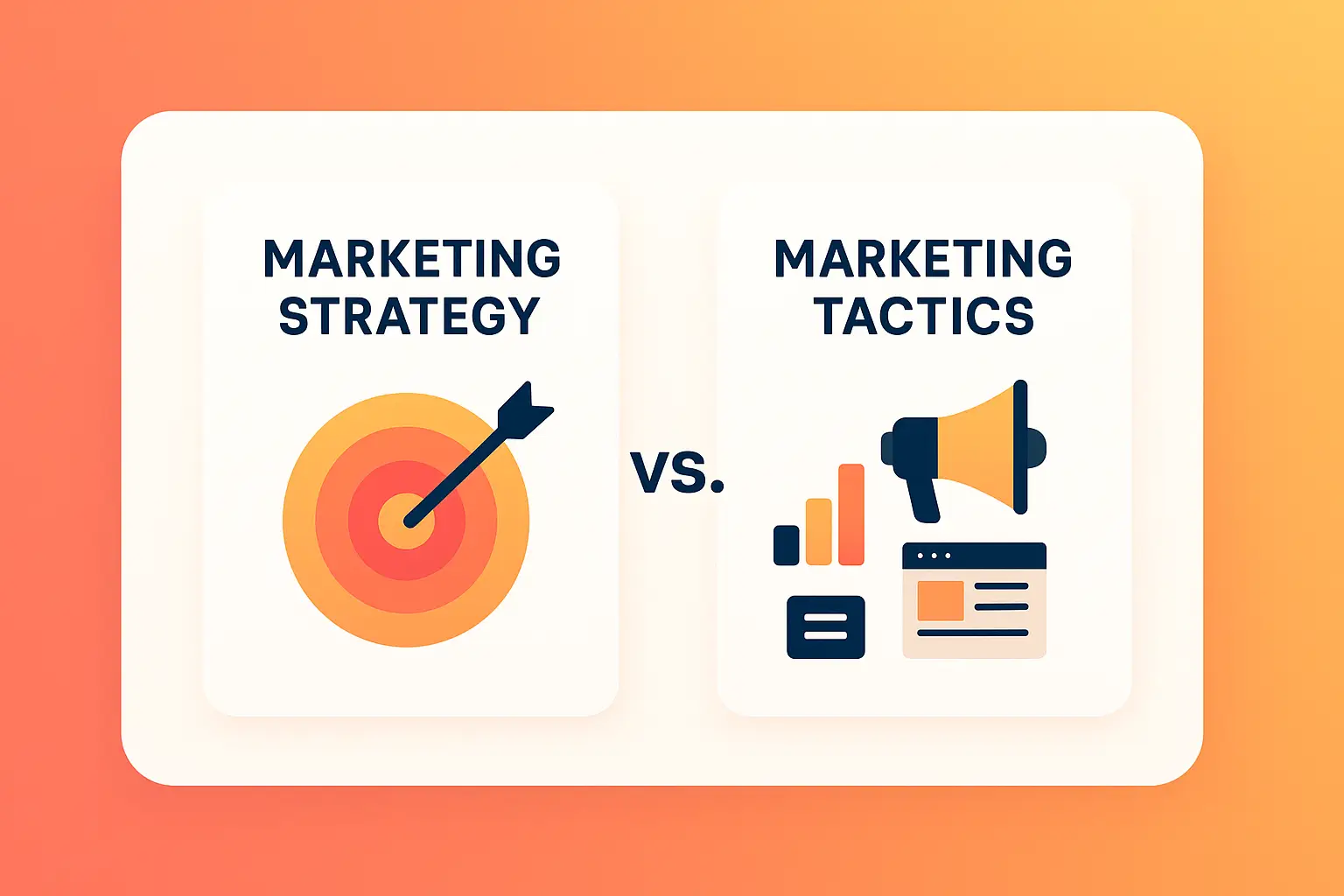
How Marketing Tactics Support the Strategy
Marketing tactics are the detailed steps used to execute the strategic plan. They include the tools,
channels, experiments, creatives, and workflows used in day-to-day operations. Tactics are not long-term
commitments; they change when data shows that a different direction produces better results.
Examples of tactics include:
- Writing and publishing SEO-optimized articles
- Running Google Ads or Meta Ads
- A/B testing creative variations
- Launching remarketing sequences
- Creating landing pages for specific segments
- Building automated email flows
- Posting on social media
- Adjusting bids, testing audiences, and refining keywords
Tactics bring the strategy to life, but they cannot define the strategy.
A campaign may use excellent tactics, but without strategic direction, results become inconsistent
and disconnected from the brand’s goals.
Strategy vs. Tactics: A Side-by-Side View
A clear distinction between strategy and tactics helps avoid the confusion that damages campaign performance.
Strategy vs. Tactics
| Marketing Strategy |
Marketing Tactics |
| Long-term direction | Short-term actions |
| Defines purpose and priorities | Executes activity |
| Explains why and what | Shows how |
| Harder to change | Easy to modify and test |
| Connects all departments | Moves campaigns into motion |
Strategy shapes the environment; tactics move within it.
Strategy acts as the system; tactics operate inside that system.
Why Teams Confuse Strategy With Tactics
Many organizations operate in urgency mode. Content calendars must be filled, campaigns must go live,
and channels must stay active. Under this pressure, teams naturally default to action first and planning second.
This is where strategy and tactics start to merge.
- Leadership often measures outputs — posts, emails, ads — instead of outcomes
- Teams feel rewarded for activity, not for alignment or focus
- Channel specialists prioritize tools and features over direction
- Trends and algorithm changes push brands into reactive behavior
- Marketing systems lack a documented, shared strategy that guides decisions
When strategy is unclear, tactics fill the gap. The work continues, but it no longer compounds.
Symptoms of a Tactics-Only Marketing System
These are the patterns that often appear inside systems driven by tactics instead of strategy:
- Campaigns look active, but performance remains flat or unpredictable
- PPC spend increases while return on ad spend declines
- Content fails to rank because topics and formats do not match user intent
- Social media feels inconsistent or disconnected from the brand
- Reporting focuses on impressions, clicks, and volume instead of revenue
- Teams are spread across too many channels with no clear prioritization
- Messaging changes frequently, confusing both audience and internal teams
- Analytics show movement, but not real progress toward business goals
Strategy vs. Activity
If a team is “doing a lot” but cannot explain how the work connects to a clear objective,
the system is tactical, not strategic.
Your marketing might be busy — not strategic
If these symptoms feel familiar, something is missing in the system:
a strategy that connects channels, messaging, and funnel stages to measurable outcomes.
Get a strategic clarity audit →
Practical Example From Real Marketing Work
Imagine a business investing $12,000 per month in paid search.
Without a clear strategy:
- Targeting is broad and based on guesswork or basic demographics
- Landing pages do not align with the search intent behind the keywords
- Messaging focuses on features, not outcomes or differentiation
- No funnel segmentation exists for cold, warm, and hot audiences
- Campaigns compete on irrelevant or overly competitive terms
- Performance fluctuates month to month with no clear reason
The result: high cost per acquisition, low conversion rates, and constant pressure to “fix the campaigns.”
With a strategy in place:
- Audience segments are mapped to different funnel stages
- Search intent is matched with specific offers and landing pages
- Messaging pillars define how value is communicated across every ad
- Negative keywords remove wasted spend and protect the budget
- Retargeting sequences continue the conversation instead of restarting it
- Success is defined using clear KPIs tied to revenue and profitability
The same budget now supports a predictable, scalable system.
The tactic (PPC) did not change. The strategy behind it did.
The Strategy-to-Tactics Ladder
A strategy becomes actionable only when it is broken into layers that teams can execute.
This ladder prevents marketing from jumping straight from “idea” to “activity.”
- Identify the core business challenge — visibility, lead quality, conversion rate, or retention.
- Study the market — competitors, category maturity, and positioning gaps.
- Define audience and intent — how people search, compare, and decide.
- Clarify positioning and messaging — what makes the brand the right choice.
- Select channels with intention — not every channel, only the ones that matter.
- Design tactical activations — campaigns, workflows, and assets that serve the strategy.
- Measure and optimize — refine tactics continuously while protecting the strategic direction.
Practical Examples Across Key Marketing Disciplines
SEO
Strategy: identify the core topics the business must own, the search intent behind audience behavior, and the areas where the brand can outrank competitors.
Tactics: build keyword clusters, optimize on-page elements, strengthen internal linking, improve technical foundations, and publish supporting content that builds topical authority.
PPC
Strategy: define the role of paid traffic in the funnel, the audiences that produce profitable returns, and the value proposition that attracts qualified leads.
Tactics: build segmented campaigns, create and test ad variations, refine negative keywords, adjust bids, test landing pages, and use automation for budget and bidding.
Social Media
Strategy: decide how the brand should appear, what voice it uses, and the long-term expectations for awareness and community.
Tactics: maintain content calendars, create short-form and long-form video, collaborate with partners, schedule posts, and manage daily community engagement.
Email Marketing
Strategy: define how email supports nurturing, retention, and lifetime value.
Tactics: build segmented lists, configure automation flows, personalize content, test subject lines, and trigger campaigns based on behavior or milestones.
Building a Strong Marketing Strategy Before Choosing Tactics
Effective marketing systems follow a sequence: understand the problem, study the market,
define goals, choose the channels, build messaging, and only then plan tactical activations.
When teams reverse this order, campaigns may look active but produce little strategic impact.
A strong strategy is built through:
- Identifying the core business challenge the marketing system must solve
- Researching the audience’s intent, behavior, and buying journey
- Analyzing competitors and their positioning to find open space
- Setting measurable goals for visibility, pipeline, and conversions
- Selecting channels that match the audience’s decision-making points
- Aligning messaging with value, outcomes, and market gaps
- Prioritizing actions based on impact, risk, and available resources
Once the strategy is established, tactics gain clarity and become significantly more effective.
Modern Tactics That Strengthen Strategy in 2025
Digital tactics have evolved quickly with AI, performance automation, and intent-focused search.
The most effective tactics today are the ones that extend and reinforce a clear strategic direction.
- High-intent content clusters aligned with research-driven queries
- Multi-step PPC funnels built around segmented audiences
- First-party data systems that strengthen remarketing and personalization
- Combined email and SMS nurturing for key stages of the funnel
- Conversion-focused UX improvements to remove friction from journeys
- Fast experimentation with structured A/B testing cycles
- Omni-channel remarketing strategies that keep messaging consistent
- Performance-based creative sequencing guided by real data
- Behavior-driven automation that reacts to how people actually interact
Each of these tactics gains power only when supported by a well-defined strategy that guides where,
when, and why they should be used.
The Risks of Mixing Strategy and Tactics
Many performance issues originate from treating tactics as strategy.
Brands that run ads without audience clarity, publish content without understanding search intent,
or produce activity without tracking outcomes fall into an expensive cycle of inconsistency.
Common risks include:
- Wasting budget on tactics that do not align with business goals
- Publishing content that fails to rank because it lacks strategic purpose
- Prioritizing volume over relevance and impact
- Changing campaigns too frequently, preventing optimization from compounding
- Splitting focus across too many channels at once
- Reacting to trends instead of shaping a long-term position in the market
- Measuring outputs instead of outcomes that tie back to revenue
A marketing system becomes strong when strategy guides the work and tactics amplify it.
When Strategy Leads
When strategy drives the system, tactics stop being noise and start compounding results.
Every campaign becomes part of a bigger picture instead of a disconnected effort.
Turn strategy into predictable performance
If your channels feel disconnected or results stay inconsistent,
it’s time to build a strategy that aligns positioning, funnel stages, and execution.
Talk strategy →